Risk & Safety
Bitcoin in Rupees vs Dollars: How the Weak Rupee Changed Returns for Indian Holders
Bitcoin is down 8.7% this year in dollars but only 3.5% in rupees. We analysed 9 years of data to show how the rupee changed returns for Indian holders.
Open any global crypto app today and Bitcoin is down 8.7% for 2026, trading near $80,000.
Now do the same calculation in rupees. Bitcoin is down only 3.5%.
Same coin. Same dates. A very different year. The difference is the rupee. Since January, a dollar has become 5.7% more expensive in rupees, and every dollar-priced asset an Indian owns, Bitcoin included, has gained that much in rupee terms.
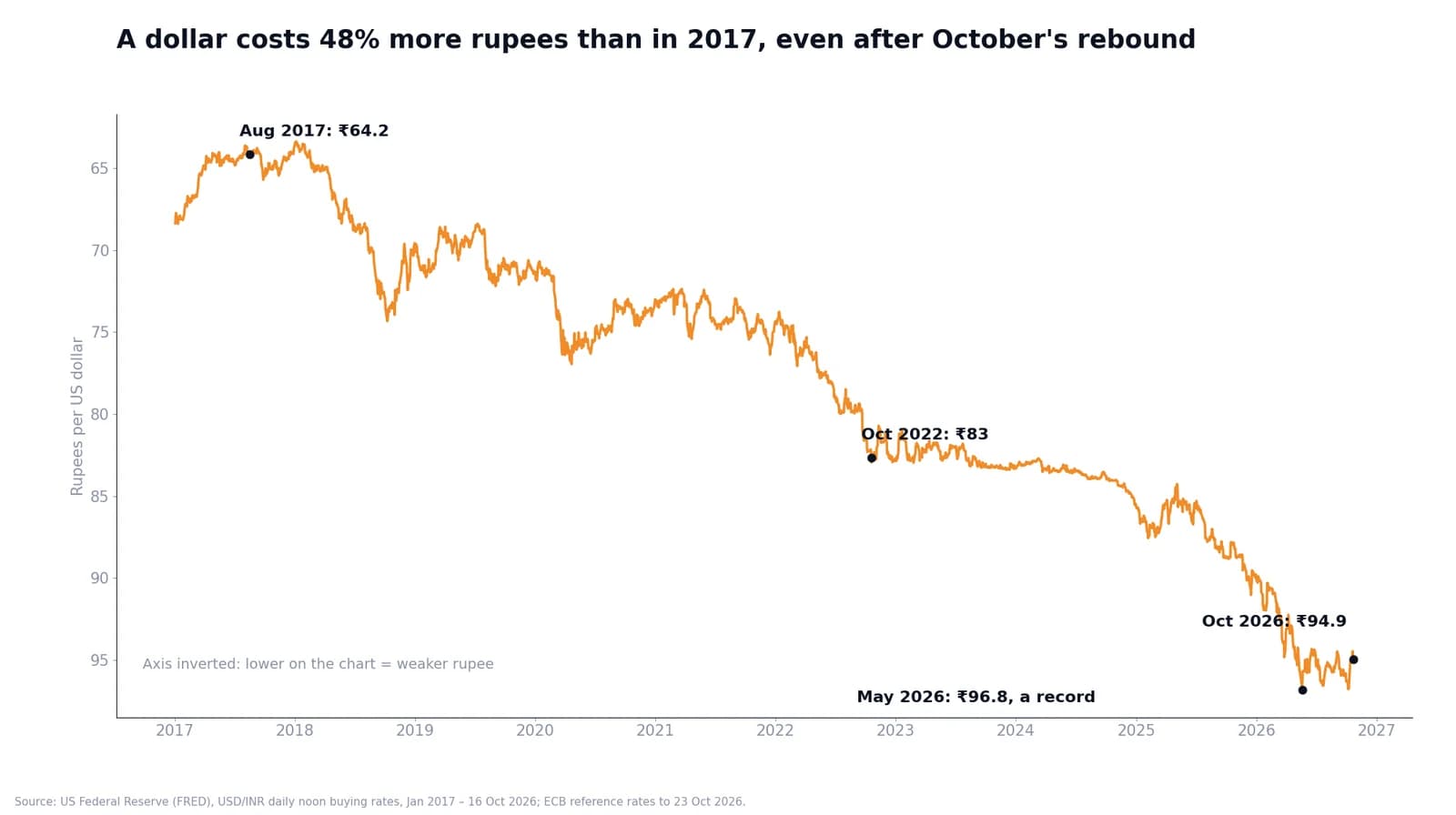
But look at the last month and the picture flips. In mid-October the Reserve Bank of India stepped in hard, and the rupee bounced from near ₹97 to about ₹94.9 per dollar. Over the past month, Bitcoin fell 5.2% in dollars and 6.1% in rupees. The currency that cushioned Indian holders all year took that cushion away in a matter of days.
That raises three questions every Indian crypto holder should be able to answer. How much of my return was Bitcoin, and how much was the rupee? How reliable is that rupee effect? And does the price I pay on an Indian exchange even match the global price?
We went through nine years of data to find out: every daily Bitcoin close since August 2017, the official dollar–rupee rate, and the rupee prices of Bitcoin and USDT on a major Indian exchange since February 2024. The short version: the weak rupee has added to Indian Bitcoin returns every calendar year since 2018, but it is a currency effect, not a trading edge, it can reverse quickly, and Indian buyers pay a premium most people never notice. That premium has just widened to about 6%.
What has happened to the rupee
The rupee spent most of 2026 under pressure, and several causes pulled in the same direction:
- Oil near $100 a barrel. India imports most of its oil. With supply through the Strait of Hormuz disrupted, a higher oil bill means more dollars leaving the country.
- Foreign investors selling. Foreign investors sold almost $30 billion of Indian shares this year, and each sale ends with rupees being converted back into dollars.
- A strong dollar and high US yields. The US Federal Reserve has kept policy tight, which keeps the dollar in demand worldwide.
The rupee hit a record low near ₹97 in May, and was back near that level in early October.
Then the RBI pushed back. In mid-October it restricted the rebooking of cancelled foreign-exchange derivative contracts, separated oil companies' large dollar purchases from the open market, cut the size of currency trades allowed without proof of an underlying need from $100 million to $5 million, and put a 20% cash reserve requirement on certain rupee derivatives. Within about two weeks the rupee recovered to around ₹94.5–95.
Analysts quoted by CNBC still expect the rupee to weaken again towards ₹100 per dollar into 2027, because oil, foreign flows and the dollar have not changed. Whether that happens or not, October showed how quickly the currency can move in both directions.
Same coin, different returns
Here is Bitcoin's return over different periods, measured in each currency, to 26 October 2026:
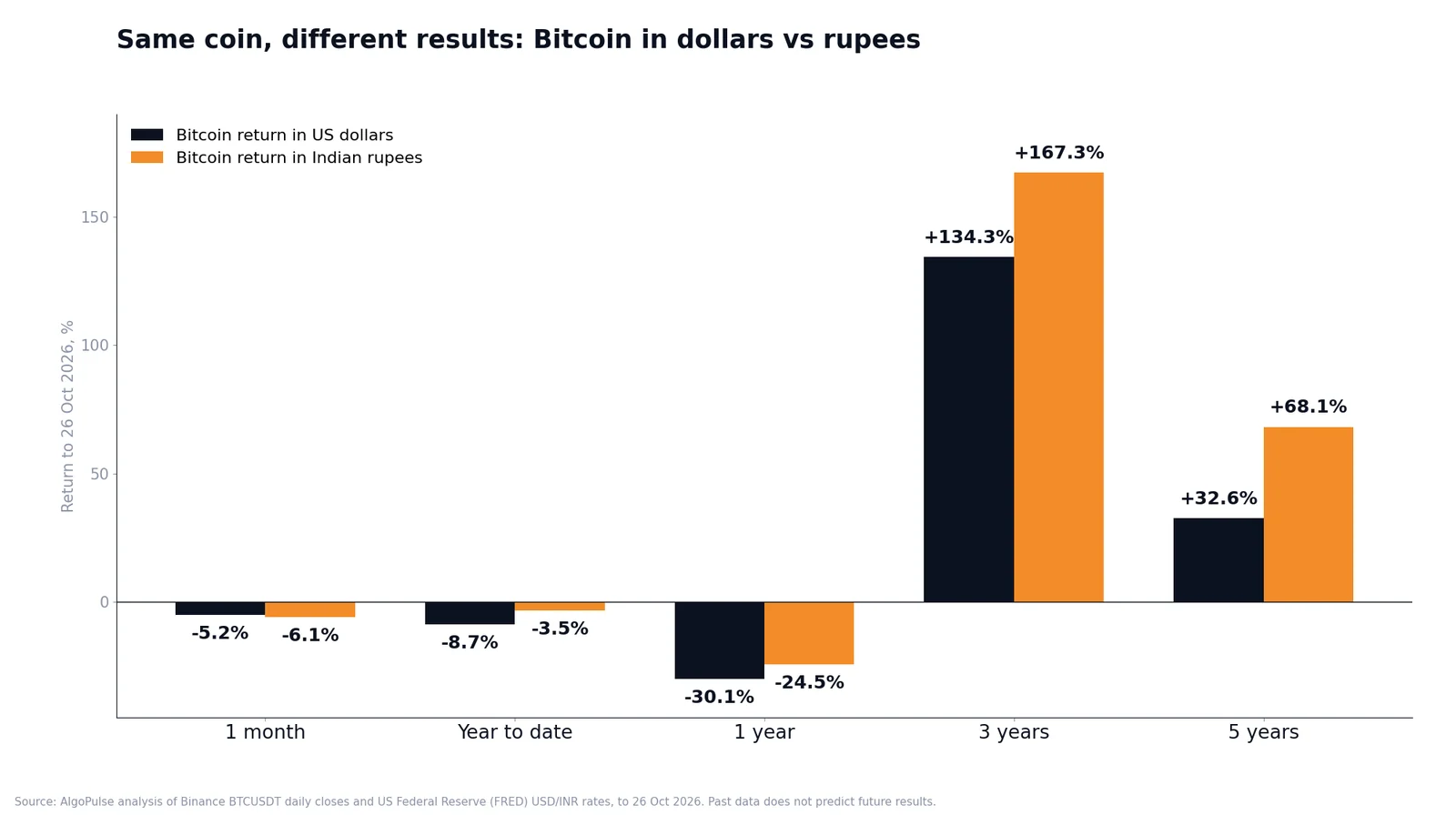
| Period | Bitcoin in US dollars | Bitcoin in rupees | Dollar's change against the rupee |
|---|---|---|---|
| 1 month | −5.2% | −6.1% | −0.9% (rupee stronger) |
| Year to date (2026) | −8.7% | −3.5% | +5.7% |
| 1 year | −30.1% | −24.5% | +8.1% |
| 3 years | +134.3% | +167.3% | +14.1% |
| 5 years | +32.6% | +68.1% | +26.8% |
| Since August 2017 | +1,768% | +2,664% | +48.0% |
In money terms: ₹1 lakh put into Bitcoin five years ago would be worth about ₹1.68 lakh today. Measured in dollars, the same investment grew only about 33%. Roughly half of the rupee return came from the currency, not from Bitcoin.
The effect compounds. Over a few months the rupee adds or subtracts a few points. Over five years it doubled the return.
The rupee has slipped every year since 2018
This is not a one-year accident. Here is how much the dollar rose against the rupee in each calendar year, and what that did to Bitcoin's return for an Indian holder:
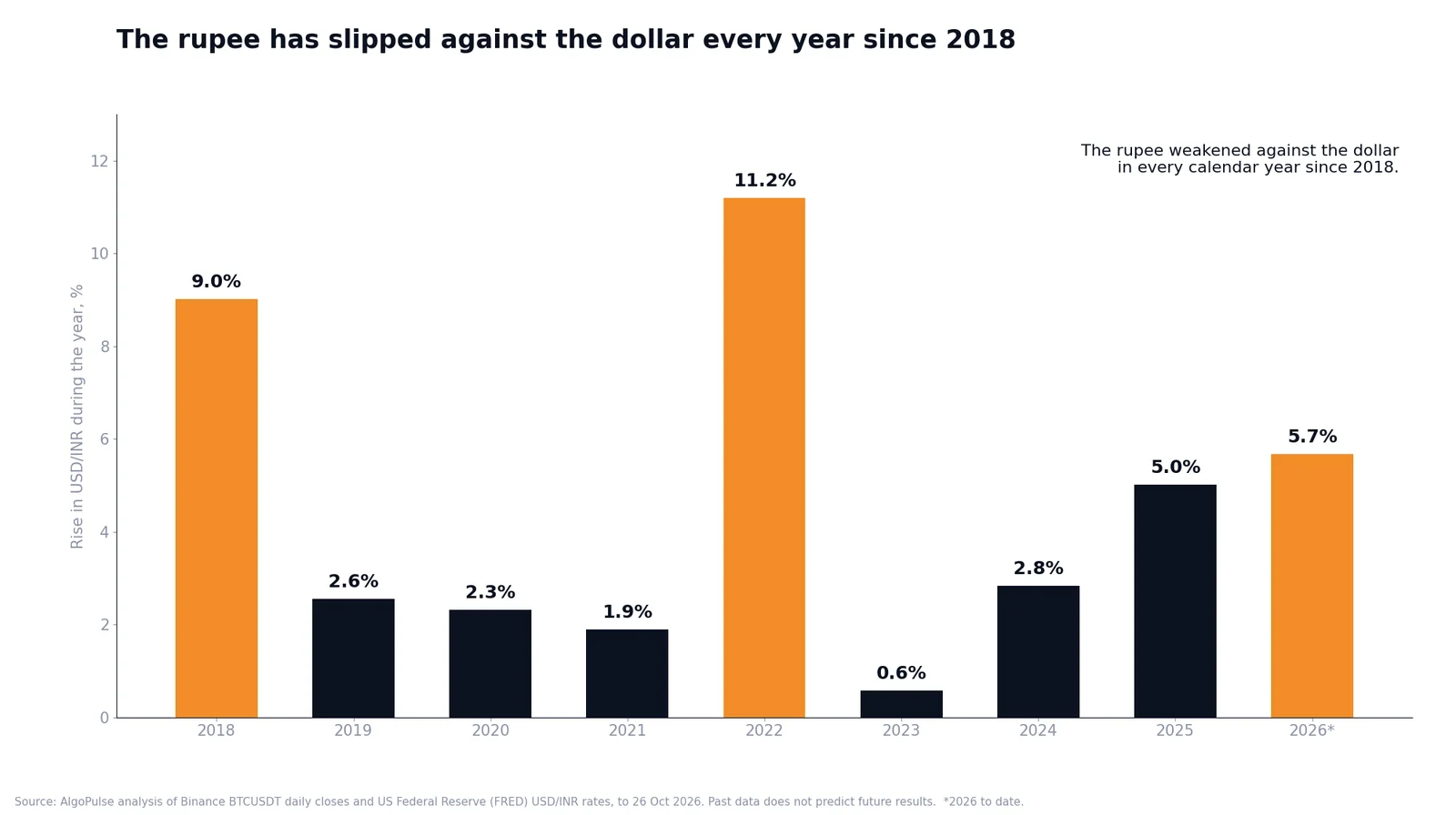
| Year | Bitcoin in dollars | Bitcoin in rupees | Dollar's rise against the rupee |
|---|---|---|---|
| 2018 | −73.0% | −70.6% | +9.0% |
| 2019 | +94.3% | +99.3% | +2.6% |
| 2020 | +302.0% | +311.3% | +2.3% |
| 2021 | +59.8% | +62.8% | +1.9% |
| 2022 | −64.2% | −60.2% | +11.2% |
| 2023 | +155.6% | +157.1% | +0.6% |
| 2024 | +121.3% | +127.6% | +2.8% |
| 2025 | −6.3% | −1.6% | +5.0% |
| 2026 (to 26 Oct) | −8.7% | −3.5% | +5.7% |
Two patterns stand out.
The rupee cushions the bad years most. The two biggest rupee falls, 2018 and 2022, came in two of Bitcoin's worst years. A weak rupee and a crypto sell-off often have the same cause: global investors pulling money out of riskier assets, emerging-market currencies included. So the rupee tends to soften Bitcoin's losses exactly when they are largest. It is a cushion, not a shield: Bitcoin still lost 60–70% in rupees in both years.
It is not a law of nature. In 2017 the rupee strengthened by about 6% against the dollar, and October 2026 has just shown the same thing on a smaller scale. A stronger rupee cuts Indian Bitcoin returns just as surely as a weaker one boosts them.
A smaller fall from the peak
Bitcoin's highest daily close, in both currencies, came on 6 October 2025: about $124,700, or roughly ₹1.11 crore at the official rate.
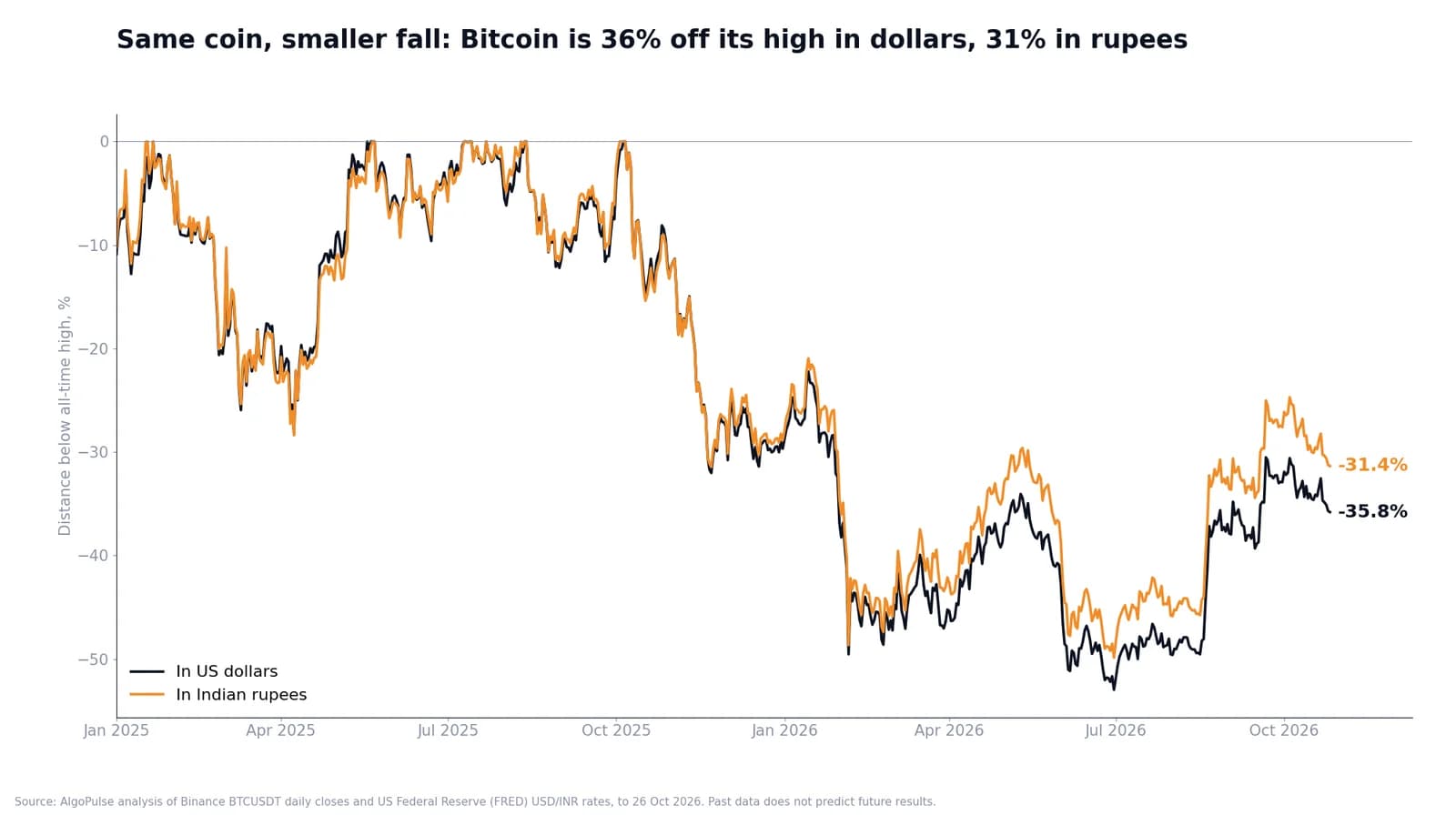
A year on, Bitcoin is 35.8% below that peak in dollars, but 31.4% below it in rupees. At its lowest point, in mid-2026, the dollar drawdown passed 50%, while the rupee drawdown stayed a few points smaller.
For an Indian holder, this downturn has been real, but less severe than the global headlines suggest.
Along the way, Bitcoin passed some milestones in rupee terms at the official rate:
| Milestone | First reached |
|---|---|
| ₹50 lakh | 28 February 2024 |
| ₹75 lakh | 13 November 2024 |
| ₹1 crore | 11 July 2025 |
The premium most Indian buyers never notice
So far we have converted Bitcoin's global price at the official rupee rate. But Indians do not buy at the official rate. They buy on Indian exchanges, in rupees, and there the dollar costs more.
We compared the rupee price of USDT, the dollar-pegged token most Indians use to fund crypto futures, on a major Indian exchange with the official dollar–rupee rate, every day since February 2024.
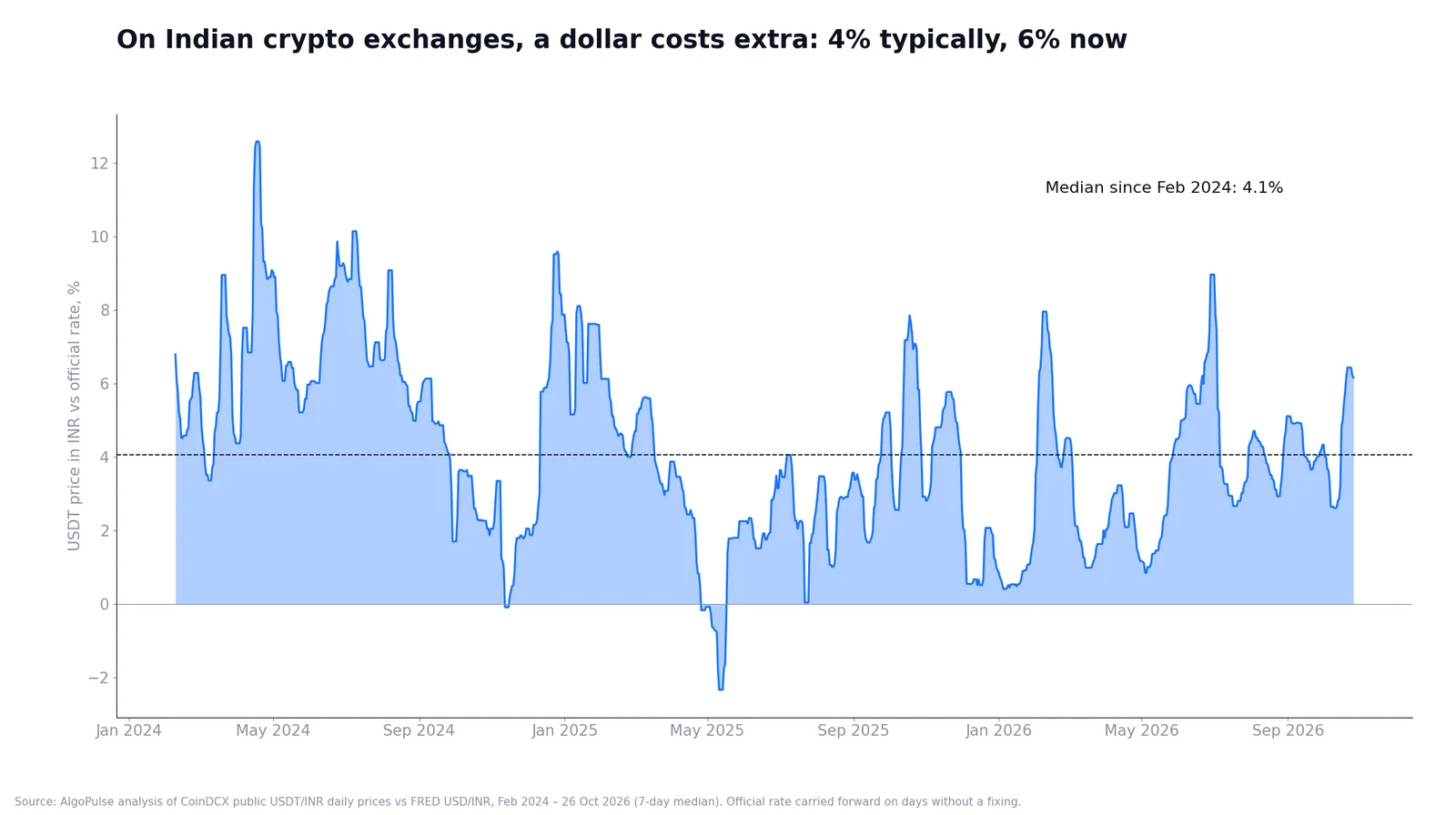
- USDT traded a median 4.1% above the official rate. On 26 October it cost about ₹100.7, against an official rate of ₹94.9: a premium of about 6%.
- Bitcoin's rupee price carries the same premium. On the same day it traded around ₹80.7 lakh, about 6.2% above its global price converted at the official rate (about ₹76 lakh).
- The premium moves a lot. Using a seven-day median, it ranged from about −2% to above 12% over the period.
October shows how this works in practice. Between 9 and 26 October, the official rate fell from ₹96.7 to ₹94.9 per dollar as the rupee strengthened. Over the same days, USDT on the Indian exchange actually rose, from about ₹99.5 to about ₹100.7. So the premium widened from under 3% to about 6%. Indian crypto buyers did not get the benefit of the stronger rupee; the gap simply grew.
Why does the premium exist at all? Commonly cited reasons include strong Indian demand for dollar-linked tokens, limited and costly routes to move rupees into crypto, and the 1% TDS on crypto transfers. We have not proven the cause, but the size of the gap is clear in the data.
Six mistakes Indian crypto holders make with currency
1. Reading global headlines as your own return
"Bitcoin down 8.7% this year" is a dollar number. Your rupee return is different, and so is the rupee price you actually paid. Measure your results in the currency you live in.
2. Mistaking the rupee's fall for trading skill
If your rupee returns beat the global numbers, part of that is the currency, which helped everyone holding a dollar asset. It says nothing about your entries, your exits or your strategy.
3. Ignoring the premium on the way in and out
Buying USDT at a 6% premium and selling at a 1% premium costs you 5% before the trade begins. Check the gap between the exchange's USDT price and the official rate before you convert large amounts. Right now that gap is wider than usual.
4. Assuming the rupee only goes one way
It strengthened in 2017, and again in October 2026 when the RBI stepped in. A rupee rebound cuts rupee returns on every dollar-priced asset at once, as the past month's numbers show.
5. Forgetting that the currency part is taxed too
India taxes gains on crypto assets in rupees. If part of your rupee gain came from the weaker rupee, that part is taxed as well. Our guide to crypto tax and rules in India covers the basics; a chartered accountant should confirm how it applies to you.
6. Not knowing which currency your margin is in
Futures margin is held in different currencies on different exchanges. Some use USDT, some settle in US dollars, some hold margin in rupees. That choice decides whether your trading account carries currency exposure at all.
How different traders might think about this
General education only, not personalised advice.
Long-term holders
Track your returns in rupees, using the price you actually paid on an Indian exchange. Treat the rupee's contribution as a currency effect that could shrink or reverse, not as something Bitcoin did.
Futures traders with USDT margin
On CoinDCX, Shark Exchange, CoinSwitch PRO and Bybit, margin and profit and loss are in USDT, and on Delta Exchange India they settle in US dollars. Your trading account is effectively a dollar account. When the rupee weakens, its value in rupees rises; when the rupee strengthens, as it did this month, it falls. Our crypto futures guide explains how margin currencies work, and the CoinDCX funding guide shows the rupee-to-USDT step.
Traders who want to stay in rupees
Pi42 offers perpetuals where margin and results are in rupees. That removes the conversion step and the premium, but the contract still tracks a dollar-priced coin, so its rupee price still moves with the exchange rate.
Anyone comparing crypto with other investments
When you compare Bitcoin with a fixed deposit or the Nifty, use rupee returns for all three, over the same dates. Otherwise you are comparing a dollar number with rupee numbers.
A checklist for Indian crypto holders
- I know my return in rupees, using the price I actually paid, not just the global dollar price.
- I know how much of my gain came from the rupee and how much from the coin.
- I check the USDT price on my exchange against the official rate before converting large amounts.
- I know which currency my futures margin is held in.
- I remember that the rupee can strengthen as well as weaken, sometimes within days.
- I keep records in rupees for tax, and have asked a CA how gains are reported.
How AlgoPulse thinks about currency
AlgoPulse shows deployment results in US dollars, the way most exchanges settle perpetual futures. That keeps a strategy's numbers comparable across exchanges and over time. But your real-world result is what reaches your bank account in rupees, so convert at the rate you would actually get, premium included.
We do not try to predict the rupee. Our strategies trade the coin's price according to fixed rules, and every one comes with a three-year backtest you can read before you deploy. Funds stay on your own exchange account, connected through a trade-only API key. If you trade Bitcoin and Ether futures, our guide to algo trading them covers the basics.
Questions people ask
What is the price of Bitcoin in INR today?
On 26 October 2026, Bitcoin traded near $80,000 globally, about ₹76 lakh at the official rate of ₹94.9 per dollar. On Indian exchanges it traded higher, around ₹80.7 lakh, because of the local premium. Prices change constantly, so check a live quote.
Why is the Bitcoin price higher on Indian exchanges?
Indian exchanges price Bitcoin and USDT in rupees, and dollar-linked tokens have traded at a premium to the official exchange rate: a median of 4.1% since February 2024 in our data, and about 6% in late October 2026. Demand, limited funding routes and the 1% TDS are commonly cited reasons.
Why did the rupee strengthen in October 2026?
The RBI introduced several measures in mid-October to curb speculative dollar demand, including limits on rebooking cancelled currency derivatives and a cash reserve requirement on certain rupee derivatives. The rupee recovered from near ₹97 to around ₹94.5–95 within about two weeks.
Does a weak rupee make Bitcoin a good investment for Indians?
A weak rupee raises the rupee value of every dollar-priced asset, Bitcoin included. That is a currency effect, not a reason to buy Bitcoin specifically, and it can reverse when the rupee strengthens.
Has Bitcoin ever crossed ₹1 crore?
Yes. At the official rate, Bitcoin first passed ₹1 crore on 11 July 2025 and peaked near ₹1.11 crore on 6 October 2025.
Is my crypto profit taxed on the rupee gain or the dollar gain?
Gains on crypto assets are calculated and taxed in rupees in India, so the currency part of a gain is included. Confirm the treatment of your own trades, especially futures, with a chartered accountant.
Which Indian exchanges hold futures margin in rupees?
Pi42 offers rupee-margined perpetuals. CoinDCX, Shark Exchange and CoinSwitch PRO use USDT, and Delta Exchange India settles in US dollars.
Methodology: Bitcoin prices are Binance BTCUSDT daily closes from 17 August 2017 to 26 October 2026. Rupee rates are the US Federal Reserve's USD/INR series (FRED: DEXINUS) to 16 October 2026, extended with European Central Bank reference rates to 23 October 2026, and carried forward on days without a fixing. Rupee returns are the dollar price multiplied by the official rate. The premium uses CoinDCX's public daily USDT/INR and BTC/INR closing prices from February 2024, compared with the official rate. Calendar-year returns run from 31 December to 31 December.
Sources: CNBC, "India's rupee forecast to weaken toward 100-per-dollar level even as RBI pushes back" (16 October 2026); TradeBrains, "₹97 to ₹94: How RBI controlled dollar demand, defended the rupee"; PSU Watch, "Rupee rises 9 paise to 94.80 against US dollar as RBI intervention supports recovery"; BusinessToday, "Rupee near record low: Why RBI's multiple defences are losing effectiveness" (8 October 2026); US Federal Reserve Economic Data, USD/INR (DEXINUS).
This article is for education only and is not financial or tax advice. Crypto trading involves substantial risk. Past data does not predict future results.
Ready to try it yourself?
AlgoPulse is free — no card, no subscription. Connect your broker and deploy a strategy in about 5 minutes.
Start free